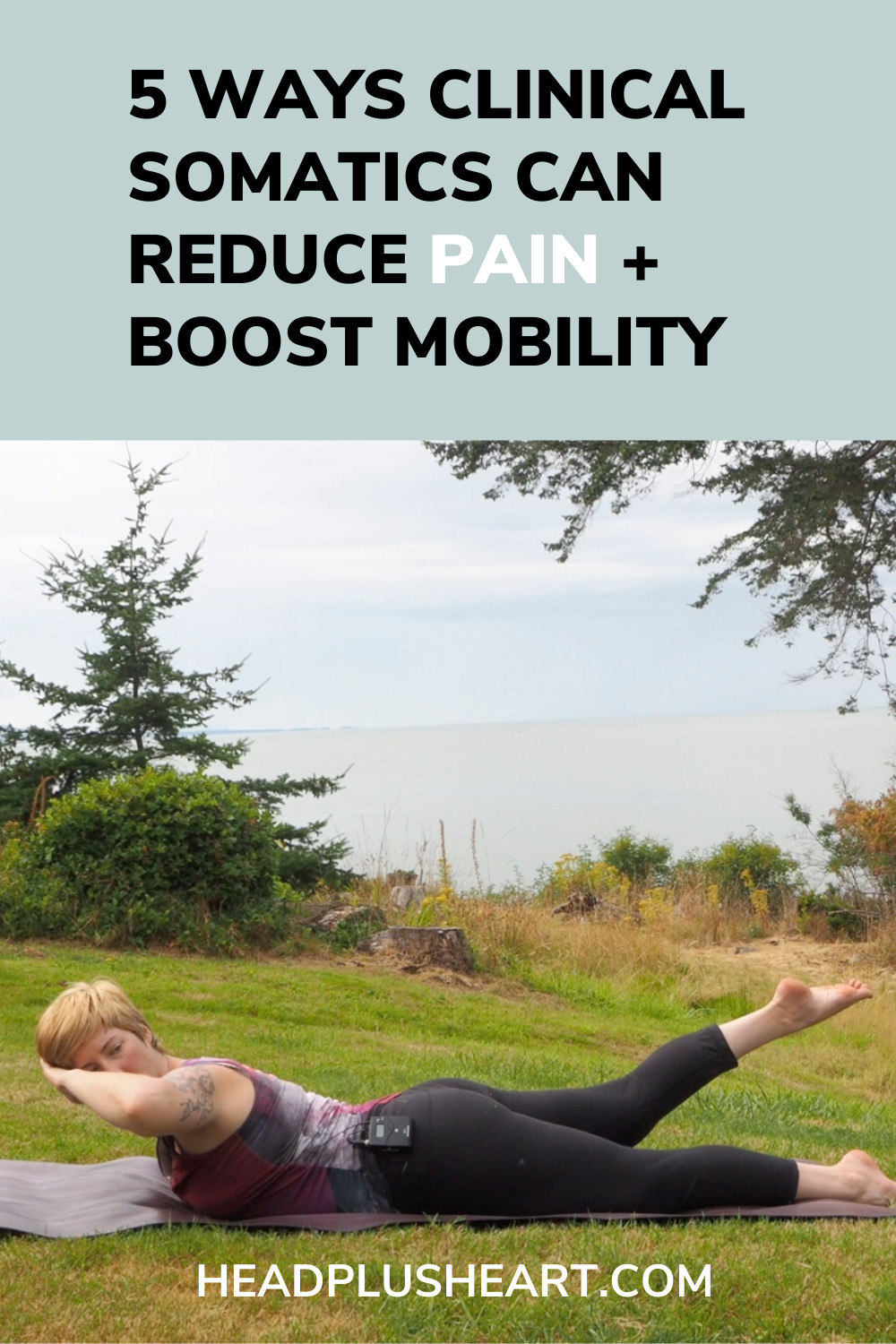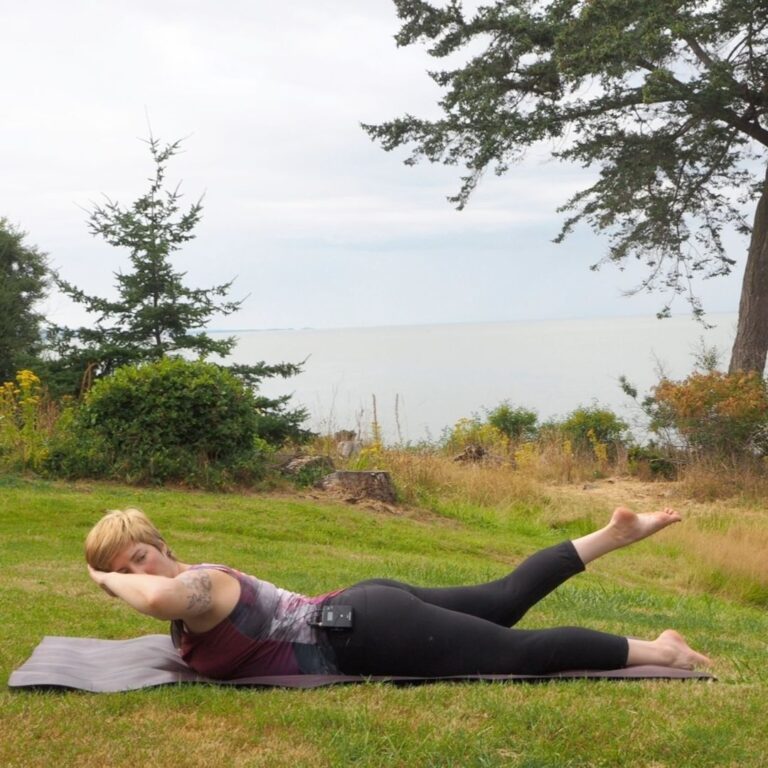
The following article on somatic yoga is written by Tania Clarke, a Restorative Movement Educator specializing in clinical somatics and restorative yoga. Here Tania explains what somatic yoga, also known as clinical somatics, actually is and how it can support your movement practice, and reduce pain. Follow Tania @movedeeplywellness
Imagine a tree swaying in the wind. It bends and moves with ease, and almost resembles liquid as the breeze swirls around and through its branches. Our bodies are designed to be just as fluid and adaptable to our actions and environment. With our modern lifestyles however, this intuitive sense of movement can be gradually forgotten.
Thankfully there are many offerings out there that help us explore movement within our bodies, but often, there’s a foundation missing, which can lead to injury, or less optimal results. In this article I’ll highlight 5 ways you can use somatic yoga to reduce pain and improve mobility.
Haven’t heard of somatic yoga, also known a clinical somatics? You’re in for a treat! This life changing practice is gradually starting to seep into the mainstream, particularly within yoga communities. Somatic Yoga is a gentle exercise methodology focused on retraining the brain to better sense and control muscles. (Note: In this article I use the terms ‘somatic yoga, ‘clinical somatics’ and ‘somatics’ interchangeably.) Results from this practice include better mobility, muscle performance, body awareness and best of all, reduced chronic pain and tension.
Once you know how to practice the somatic yoga exercises, it just takes 20-30 minutes a day to incorporate a session before or after your workouts, as a compliment to your yoga practice, or as a relaxation routine before bed.
Now, on to the details. How does somatic yoga help you build a stronger movement practice?
1. With somatic yoga, you’ll be able to control your muscles better than ever, with more range of motion.
A reality of being human is that over the years, your muscles start to get tighter, and your nervous system keeps them in a gamma feedback loop to ensure you’re “ready to go” at any moment for the tasks you do on a regular basis. No amount of stretching can get these tight muscle fibres back to a healthy, limber state. That’s where Clinical Somatics comes in.
The slow, methodical exercises retrain your nervous system to connect more efficiently with your muscles. The exercises use a method called pandiculation, which brings muscles back to a more optimal resting state.
This method lengthens muscles through a learning process. It’s a lot more “bang for your buck” than stretching, as the learning process increases your muscle control along with range of motion. You can learn more about stretching vs. somatics here.
The effects last much longer as a result, and with regular practice, keep your muscles in top shape.
2. With somatic yoga, you’ll develop your “sixth sense” in body awareness and reduce chances of injury
Did you know we have a sixth sense? It’s called proprioception, and it’s something that we can begin to lose the more we do the same types of activities. Yes, even athletes run into this problem! If you do the same type of activity often, your body is going into the same positions all the time. This begins to change your posture. Somatic yoga helps you fine-tune this ability to sense your posture, and your body in space.
This ability is especially important when we start to do different activities with different surroundings, which is when injuries are more likely to happen. You’ll start to feel like you can do those ninja moves you’ve always dreamed of. Ok, maybe just being able to skip every second step up the stairs is more your pace – wherever you’re at, somatics can make you feel much more stable and confident in your movement!
3. Somatic yoga helps bodies to recover faster
I used to diligently stretch after every workout, but most of the time, I’d still feel sore the next day, or for days after. When I started practising somatic yoga, this immediately started to change. As mentioned in point #1, somatic yoga helps release tight muscles by retraining the nervous system to relax them more fully. If you practice somatics after your workout, you’ll leave your muscles in much better shape for your next session.
Personally I combine a bit of stretching and follow up with somatic yoga. Stretching is great for elongating healthy muscle fibres, but somatics is where the magic happens when it comes to restoring your tight muscle fibres to that healthy state.
4. You’ll feel even more relaxed in your mind and body
My students love telling me about how relaxed they feel after every somatic yoga practice. Many of them say they’ve never felt so relaxed after an exercise session. The effects that clinical somatics has on the brain is very unique, and that translates into not only having a relaxed body, but also a relaxed mind.
Over time you’ll be able to perform better under pressure in everything you do, and be less inclined to feel stressed. People who feel more stressed usually have more muscle tension, and this is a fantastic practice to have in your exercise toolbelt to reduce that in your life.
5. Somatics ensures you’ll enjoy moving your body for years to come
The more we exercise, the more likely we are to injure ourselves… simply by way of increasing the odds! But this is especially true when we keep pushing ourselves without spending enough time to recover. Getting older means getting more wear and tear in your body, but the restorative effects of somatics can turn back the clock.
Think of it like tuning up your car. The less you do so, the sooner it will break down. The same goes for your body. If you love exercising and work your body hard on a regular basis, it’s in your best interest to start incorporating a somatic yoga practice, so you can keep enjoying the activities you do for years to come.
The same goes for if you’re more of a casual exerciser, or prefer to just stick to the odd walk – somatics is your best friend for staying active and mobile into your oldest years!
Somatic Yoga Resources
If you’d like to learn more or experience Tania’s work for yourself, you can try her Five Day Challenge, which she offers free of charge. The challenge offers a series of exercises that target commonly tense parts of the body, to immediately help you relieve common conditions such as neck pain, lower back pain, shoulder pain and hip pain. We also recommend Tania’s deeper dive, a 30 day somatics program, which guides you to incorporate somatic yoga/clinical somatics into your life on a daily basis over the course of 30 days, for deep transformation.
A Somatic Yoga Practice
SAVE TO YOUR WELLNESS BOARDS ON PINTEREST