
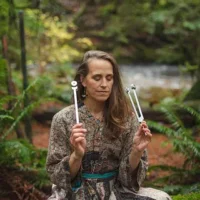
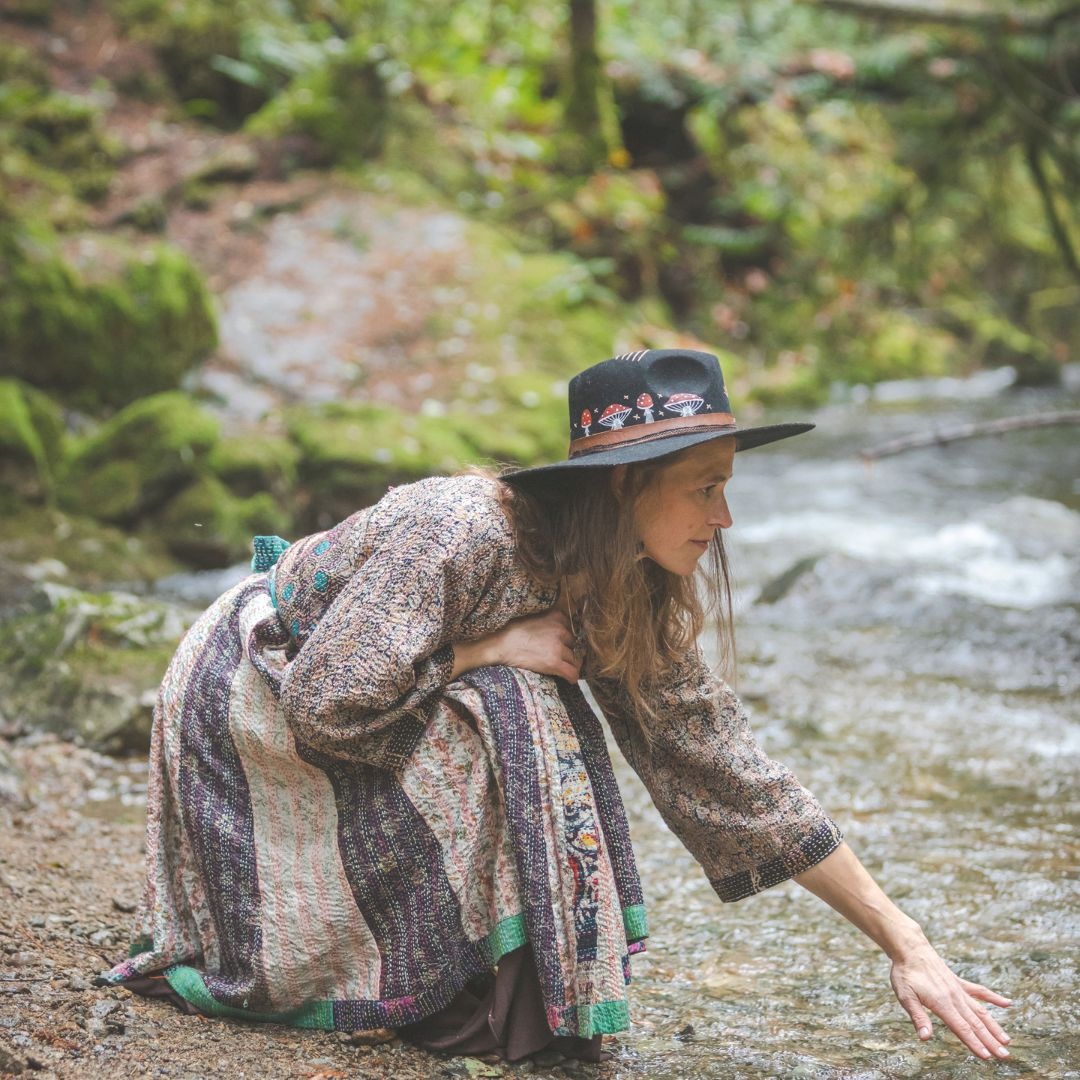
What is regenerative living, you ask? It’s handling soil, gazing at the rising sun and dipping toes into a nearby creek. These practices reconnect us with the raw vitality of nature. We are meant for this tactile belonging, grounded and elevated at once. We all share a connection with the earth. Our bones, blood, and lungs mirror the elements themselves. So, how can we maintain or re-establish our connection with the natural world around us?
My journey through permaculture to a new way of living
More than 10 years ago, I co-founded a permaculture organization called Gaia’s Guild with a dear sister. She and I would advocate for listening to the land to hear what it had to say as well as observe the myriad of elements. Our clients were encouraged to observe their habitats through peak growing seasons, noting sectors of shade, sun, wildlife, water, and human activity before any design was applied. We had preliminary contemplations with the land together to tune in. Going more deeply in my own process, I worked with a practitioner who guided me on a shamanic journey to the spirits of the land. Asking permission became a foundational step for both myself and my landmate before purchasing land.
Regenerative living begins with listening to the land, and to each other
The principle of “observe, interact, and apply” is key to permaculture. This principle results in a deepening of both inner and outer understanding – connection and attunement to the living world. The living web of ecosystems has much to communicate when given time and attention. In Andean traditions such as the Pachakuti Mesa tradition, there are many spirits of the land including the elemental beings, spirits of rocks and crystals, alongside the plant spirits and wisdom carried by the trees and water. Prayers and offerings to connect with these spirits are part of a regular gratitude practice – which is a sacred reciprocity practice central in many cultures.
Regenerative living draws from wisdom traditions
Permaculture is a design framework inspired in part by indigenous land-based wisdom and ecological observation. It is a worldview rooted in living in harmony with nature – understanding ourselves as part of it and recognizing nature as a guide.
Designing for regenerative culture (permanent culture) can be applied to all systems, from farm and garden to education and economics. It is a framework that is rooted in the ethics of caring for people, the planet, the future and fair share. This is the crux of the work I’m here to do- which explores the interconnection between caring for the planet & caring for people.
The following quote from Einstein sums this up beautifully!
“A human being is part of a whole, called by us the ‘Universe’ – a part limited in time and space. He experiences himself, his thoughts, and feelings, as something separated from the rest—a kind of optical delusion of his consciousness. This delusion is a kind of prison for us, restricting us to our personal desires and to affection for a few persons nearest us. Our task must be to free ourselves from this prison by widening our circles of compassion to embrace all living creatures and the whole of nature in its beauty.” – Albert Einstein
Focusing on the Above and Below, Within and Without
Balancing yin and yang and finding harmony in one’s inner environment is central to energy work, and regenerative living. Many modalities, including Biofield Tuning and Reiki, begin by establishing energetic connection to the earth below and the space above, opening a clear central channel and listening deeply to the living systems of the body as well as the electromagnetic field. Using tuning forks, one can establish a connection to the toroidal / electromagnetic field around the body; listening deeply to the static that sound helps illuminate. At times, the field may signal distress or discomfort, and reharmonization can begin simply by remaining present with what arises.
This way of listening applies equally to observing and interacting with the land around you. Both require intelligence, attunement, and responsiveness rather than control.
Without sufficient internal resourcing, overwhelm can occur. Grounding and drawing stability from the earth helps regulate and support the system. Just as roots draw unseen nourishment, grounding practices like walking barefoot on the earth and touching soil stabilize our inner world so that growth becomes sustainable.
Understanding the connection between head, heart, and rooted connection
We are microcosms of the macrocosm, which is why personal and ecological healing are deeply interconnected, patterned in similar ways.
Using a metaphor of a tree – stable, rooted and resourced from below, the heart in the centre of the trunk and the mind extending outward like a canopy – we can draw parallels with our human experience. The trunk holds the history of the tree in its rings, just as our bodies hold memory. The mind can be seen as processing and integrating light. It brings light down into the heart and deeper layers of the body, where growth and development occur. This then comes in through the heart and energetic field. The roots anchor and nourish through our grounding practices. The trunk integrates and strengthens in our emotional life. The canopy reaches toward light, generating ideas, shaping culture, and bringing vitality to the systems we design.
When all three are tended, connection becomes not just a feeling, but a way of life. What we practice internally inevitably shapes how we design externally.
The link between constricted energy in nature, and in humans
Over the years with Gaia’s Guild, our land-based work evolved has alongside our healing practices. We studied Reiki together; she later trained in Somatic Counselling, and I in Biofield Tuning. Through our practices, and observing others in general, we developed a growing awareness of stress, anxiety, and stored or constricted energy within many people. Like the outer landscape, inner landscapes are equally unique. Somatic therapy explores where and how constricted energy is held in the body, while sound and vibrational work engages the biofield, meridians, and pathways of energy flow. Emotional blockages resemble dams in a waterway. When flow is obstructed, pressure builds. In a healthy system, water moves around rocks and fallen logs, pooling where needed, sinking slowly into the earth. In landscape design, water is directed to flow, pool, and be held safely for times of need, while care is taken to prevent harm as it moves beyond one’s own land.
With human emotions, our own internal water element, it is important to allow them to move. Rather than holding onto difficult emotions indefinitely or avoiding them entirely, we can let them flow long enough to be felt and acknowledged. Emotional integration is not erasing what happened, but allowing experience to be metabolized. Experiencing this depth of feeling often offers insight into the childhood roots of our reactions.
Somatic and sound-based practices encourage emotions to surface and then settle. In sound healing such as Biofield Tuning, often few words are needed; the work happens through sensation. Integrating these experiences strengthens the body and energetic field over time, creating containment – increasing the capacity to respond to challenging interactions rather than react. As the primary roots of reactivity are tended to, channels of flow within become clearer.
Fostering a regenerative paradigm
When vision grows without roots, it becomes ideology. When roots deepen without vision, growth stagnates. Regenerative living requires both.
We are connected to nature in countless ways—through the food we eat, the water we drink, and the land we inhabit. From the combined lens of healing and landscape design, the opportunity is recognizing what is present and shaping conditions that foster balance and beauty.
By learning to tune in, tend to and design both our inner and outer worlds with care, in harmony with the living systems around us, we reconnect, realign, and create the conditions needed for all to thrive.
Designing a life of connection asks us to observe, to listen, to respond rather than control. When we tend both soil and soul with the same care, we participate in regeneration — within ourselves and in the world we share.
About Dana Wilson
With over 15 years of training in holistic healing modalities, including Permaculture, Biofield Tuning, Kinesiology, and Reiki, Dana offers a grounded, integrative approach to both sustainable living and energy work. If you are curious to learn more about Dana, or would like to book an in-person or distance session, learn more about Dana or contact her: at aweandreverence@protonmail.com
