The following article is a guest contribution from Somatic Dance guide, Tania Clarke.
Healing in Dance Form? Meet Somatic Dance.
It was 2020. I was alone and indoors for what felt like the hundredth day of lockdown. I queued up a Cercle DJ set by Lee Burridge in Bali and started my usual strength training routine. The dreamy bright melodies and groovy beats soon had me leaving my weights on the floor and dancing like I hadn’t done in months. A surge of joy hit me as my body remembered the feeling of dancing just for the sake of it, and then moments later, the tears flowed. Not for any known reason. It felt initially confusing and distressing, but soon a lightness came over me. Weeks of fear and uncertainty that had been living in my muscles were dispersing. At that time in my life, I’d heard of somatic dance, but hadn’t experienced it. This pandemic moment was the start of my journey to eventually train to guide this powerful embodiment practice.
Somatic dance is not performance, nor choreography to memorize. It is a conversation where sensation leads, and movement follows, gradually unravelling the density of forgotten memories that live in your connective tissue, muscles and organs.
Working from the “bottom up”
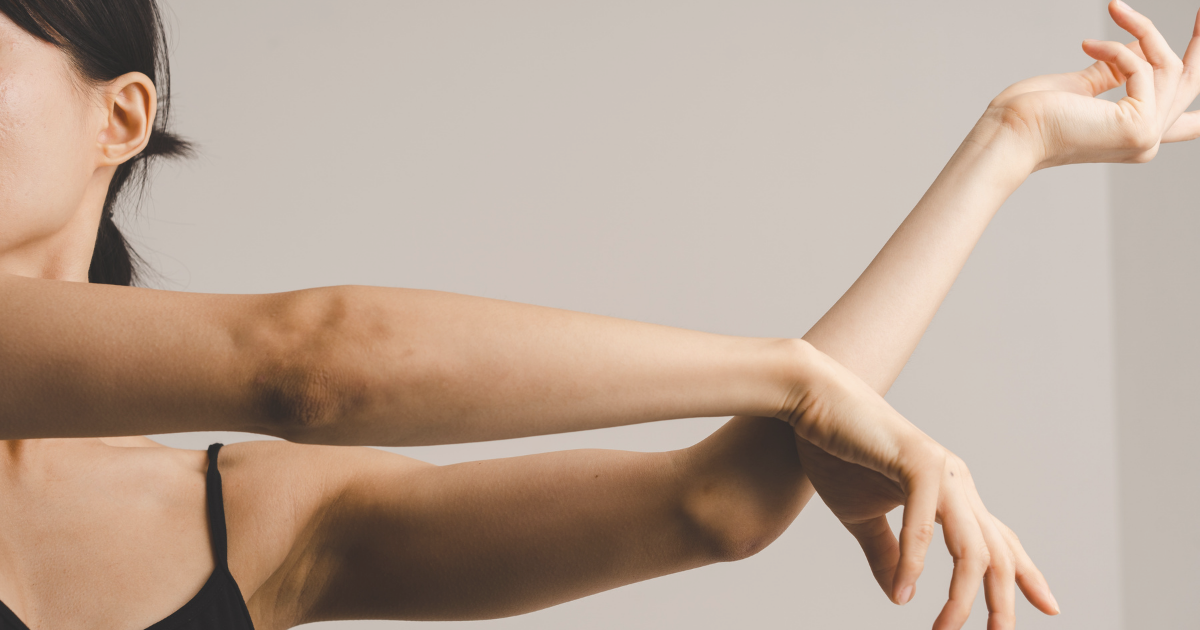
The word somatic comes from soma, Greek for “the living body.” Somatic practices work from the “bottom up”: instead of working with the mind and talk therapy (“top down”). To better understand yourself and your current challenges, you let sensation, breath, and impulse guide intuitive movement. There’s no wrong way to do it, and you don’t need to have any dance experience. If your arm wants to trace a slow circle in the air, it traces a circle. If your hips want to sway before your feet know what to do, they sway. The movement comes from within you, in real time, informed by whatever is alive in your body that day.
This isn’t just a poetic idea. Our nervous system stores experience in the body, not only in the mind’s narrative memory. This is a concept researchers call interoception: our felt sense of our own internal state. Trauma-informed and somatic therapies increasingly draw on this, using movement and body awareness to help regulate and repattern the nervous system in ways that talking alone sometimes can’t reach. When you dance without a script, you’re giving your nervous system new routes to release what words haven’t found yet.
Architecture for greater depth
During a guided somatic dance practice, facilitators give you architecture to dance within, with the intention of helping you go deeper than an ecstatic, cathartic release. For example, a dance could work with elemental wisdom (water, earth, fire, air, ether) as the architecture. When your relationship with earth is out of balance, this can show up as rumination and worry. During a dance where we work with earth, you are guided to focus on the lower body, connecting with the feet, the ground beneath you, and the power of your legs and hips. You are guided safely to dance near your edge, where things start to feel raw, with the aim of making it gradually easier to handle what life throws at you in the moment. When we dance with our emotions in a safe container, we strengthen our resilience for future encounters.
Your ember ready to be stoked
There is a creative fire in all of us that can often grow dim over the course of our day-to-day obligations and stresses. I like to refer to this as your ember. Your fire hasn’t gone anywhere. It’s just under a pile of ash, waiting for enough air and attention to catch again. Somatic dance is one of the most effective ways I have practiced that reignites that ember.
As a somatic dance facilitator and integrative healer, I prioritize weaving functional movement, session architecture, ritual, and integration into every dance, with the goal of tending the ember within you so you can return from the dance floor feeling vibrant, regulated and lighter.
It’s simpler than most people expect. You don’t need to be an advanced mover or dancer. You just need permission from yourself to be moved by your intuition, and as little as seven minutes in a day.
A short somatic dance practice to begin
I invite you to set aside a moment in a space where you can be in solitude. Put on one of your favourite songs, between 5-7 minutes. Close your eyes or have a soft gaze, and take a moment to feel your body in space. Notice where your body already wants to move, even in the smallest way — a shoulder, a hand, a sway at the hips — and follow it without deciding where it should go next.
You may feel awkward. That’s completely normal. Awkwardness is often just an old habit of self-judgment showing up uninvited. Let it be there, and keep moving.
Your body knows how to do this. It always has. Somatic dance isn’t teaching it something new so much as reminding it of something it never forgot… and giving it room to dance with and disperse those forgotten memories.
Go deeper with Tania’s work
Tania Clarke is a modern sorceress and creatrix with many passions, having spent her life exploring a wide range of paths and expressions. Now, in this chapter of her life, she has connected deeply with her role as a movement teacher and guide—one that weaves together art, music, and embodied practice to bridge the worlds of ancient nature and modern humanity. As a Dance as Medicine guide and DJ, her work is in collaboration with Spirit, using music, nature, and conscious movement to lift the collective field and support the remembrance of why we are here.
You can explore somatic dance with Tania here.